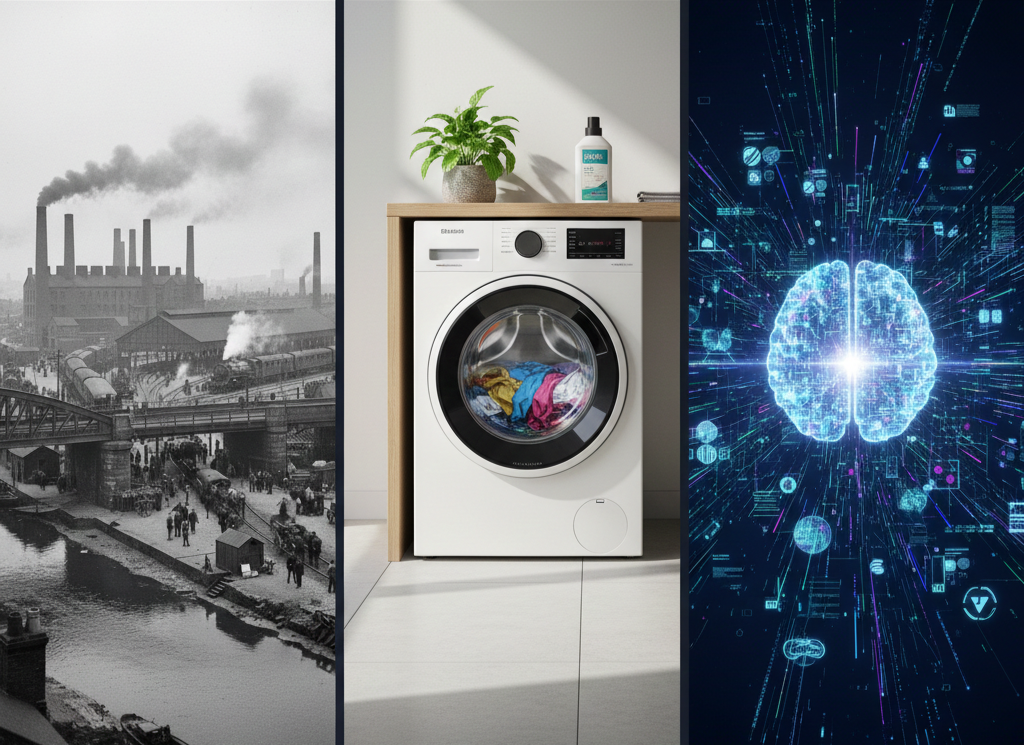
"We predict that the impact of superhuman AI over the next decade will be enormous, exceeding that of the Industrial Revolution."
This was a line said by Daniel Kokotajlo, one of the researchers behind AI 2027, a provocative forecast that outlined, step-by-step, their 'most likely' outcome of AI misalignment.
However, the true allure and differentiating factor to the report lies in how it is told. Rather than outlining facts, the report tells it as a story - a fictitious tale outlining the doom of humanity with ruthless logic. That's what really made the report so scary - it didn't read like the news, but rather like how an autonomous observer would coldly recount the story.
The connection between AI's impact and the Industrial Revolution isn't an isolated event; it's becoming a constant comparison dictating AI's impact on our future. Recently, Sir Demis Hassabis (CEO of Google DeepMind) hopped on the DeepMind podcast, hosted by Hannah Fry, to discuss consciousness and computability; he also touched on this tenuous link - here, I intend to dissect it, give my thoughts on the matter, and conclude on what this might entail for all of humanity.
Dissection - What does this link really mean?
The comparison to the Industrial Revolution is becoming the definitive link for AI. When Sir Demis Hassabis discussed this link, he isn't just talking about productivity; he's talking about a fundamental shift in human labour.
This link, as stated above, is not isolated - it is one that will forever come up given the potential for a new technology to elicit a substantial impact on the world as we know it. The Industrial Revolution remains, not a pivotal turning point, but the pivotal turning point for humanity; it was truly symbolic of the transition from rural to urban, and forever changed how we live our lives.
On the whole, we shifted (as a community) from rural areas to urban areas, further intensified by the exponential growth of jobs in factories. Holistically, conditions changed - forever. One other critical change arising almost two centuries later that I'd like to highlight was the washing machine.
Think of the washing machine. It didn't just clean clothes; it liberated thousands upon thousands of hours of human energy. We 'outsourced' the physical labour to machines, so we could pursue what was 'important' - the 9-to-5 work day. Likewise, AI is the washing machine for the mind. However, when the machine can 'think' for us, how do we redefine what is 'important'?
This link has originated because they are fundamentally the same. Both AI and the Industrial Revolution are effectively 'outsourcing' the unimportant work, and enabling us to focus on the 'important' work.
The Transition to the Now
The Industrial Revolution was a trade: we surrendered our physical labour to the engine in exchange for unprecedented scale.
With AI, we aren't just outsourcing our 'to-do list', we are outsourcing the logic of our code and the structure of our thoughts for velocity.
The "Industrial Revolution of the Mind (aka AI)" isn't a threat to our jobs — it's actually challenging our meaning as humans. If you're reliant on such tools to simply work faster and do your job efficiently, you're lacking something fundamental: the essence that makes us human. The human input and authentic creativity that only YOU can bring to the table is what actually matters. The human voice is becoming more critical and might become the only one amidst the noise of AI.
We have reached the ultimate turning point: the machines are finally ready to handle the "how," but they are forever blind to the "why."
If AI can now handle the code, the design, and the logic of your life, are you finally ready to face the silence and decide what it is you actually want to say?